Former Clayton County Sheriff Victor Hill Convicted For Restraint Chair Civil Rights Violations
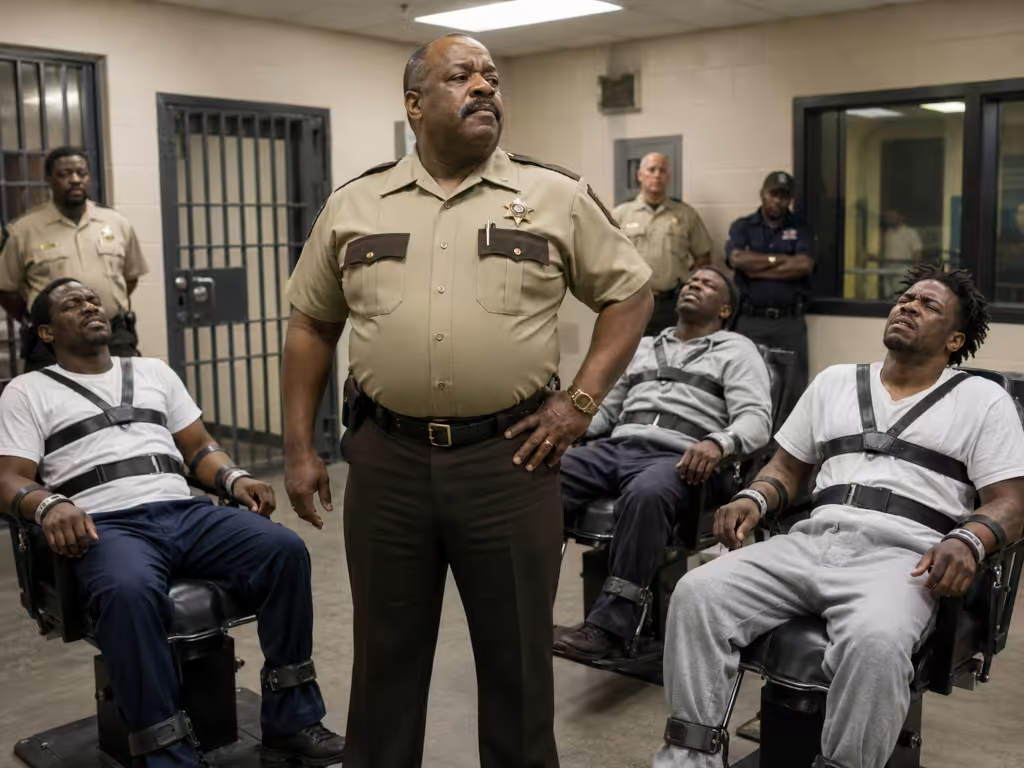
Former Clayton County Sheriff Victor Hill, once one of Georgia’s most controversial law enforcement figures, was sentenced to federal prison after a jury found that he violated the civil rights of multiple pretrial detainees by ordering them strapped into restraint chairs for hours without legal justification.
According to the U.S. Attorney’s Office for the Northern District of Georgia, Hill was convicted of violating the constitutional rights of six detainees at the Clayton County Jail. Prosecutors said the detainees were not violent, uncontrollable, or threatening at the time Hill ordered them restrained.
This was not a case about a split-second use of force in the field. The victims were already in custody. Several had been compliant. Some were handcuffed. Yet Hill used the authority of his office to have them strapped into restraint chairs and left there for hours, a use of force prosecutors said amounted to punishment.
Restraint Chair Policy Said It Was Not For Punishment
The Clayton County Sheriff’s Office had a written policy governing restraint chairs. According to federal prosecutors, the policy allowed the chair to be used for “safe containment” when an inmate was violent or uncontrollable and when other control techniques were ineffective. The same policy also made clear the chair was not to be used as punishment.
Hill ignored that restriction. Federal prosecutors said Hill ordered detainees into the chair even when they did not pose a threat. In one case cited by the Department of Justice, a 17-year-old detainee had been compliant when Hill was texted a photograph of him in custody. Hill’s response was one word: “Chair.”
In another incident described by prosecutors, a detainee asked whether he was entitled to a fair and speedy trial. Hill responded by ordering the chair brought around and telling the detainee that he was “entitled” to sit in it. The detainee was then strapped into the restraint chair for hours.
Federal Jury Convicted Hill
Hill was found guilty by a federal jury on October 26, 2022, on six counts of violating detainees’ constitutional rights. The case was brought under federal civil rights law, which prohibits officials acting under color of law from willfully depriving people of constitutional protections.
On March 14, 2023, U.S. District Judge Eleanor L. Ross sentenced Hill to 18 months in federal prison. After prison, Hill was ordered to serve six years of supervised release. During that supervised release period, he was barred from having any role in law enforcement.
The Department of Justice sentencing announcement stated that Hill’s actions caused painful injuries and eroded public trust in law enforcement. Prosecutors described the case as a clear abuse of power by an elected sheriff who was supposed to protect the people in his custody, not punish them outside the law.
Appeals Failed
Hill challenged his conviction, arguing in part that he did not have fair warning that his conduct could be criminal. The U.S. Court of Appeals for the Eleventh Circuit rejected that argument.
In its April 29, 2024 opinion in United States v. Hill, the Eleventh Circuit held that Hill had fair warning his conduct was unconstitutional, that the evidence was sufficient to convict him, and that the trial court did not coerce the jury’s verdict. The court affirmed Hill’s conviction on all counts.
Hill then sought review from the U.S. Supreme Court. According to the Supreme Court docket, his petition for a writ of certiorari was denied on May 19, 2025.
Why This Case Matters
The Hill case is a reminder that jail detainees do not lose their constitutional rights simply because they are in custody. Many people held in county jails are pretrial detainees, meaning they have not been convicted of the charges that brought them there. The Constitution does not allow jail officials to use force as punishment against people who have not been lawfully sentenced by a court.
Hill’s actions were especially disturbing because they came from the top. This was not a rogue deputy acting outside supervision. Prosecutors said Hill personally ordered the use of the restraint chairs, and the jury agreed that those orders crossed the line into criminal civil rights violations.
For years, Victor Hill cultivated a tough-on-crime public image. But in this case, federal prosecutors, a jury, a federal judge, and the Eleventh Circuit all reached the same basic conclusion: a sheriff’s badge does not give anyone the right to ignore the Constitution.