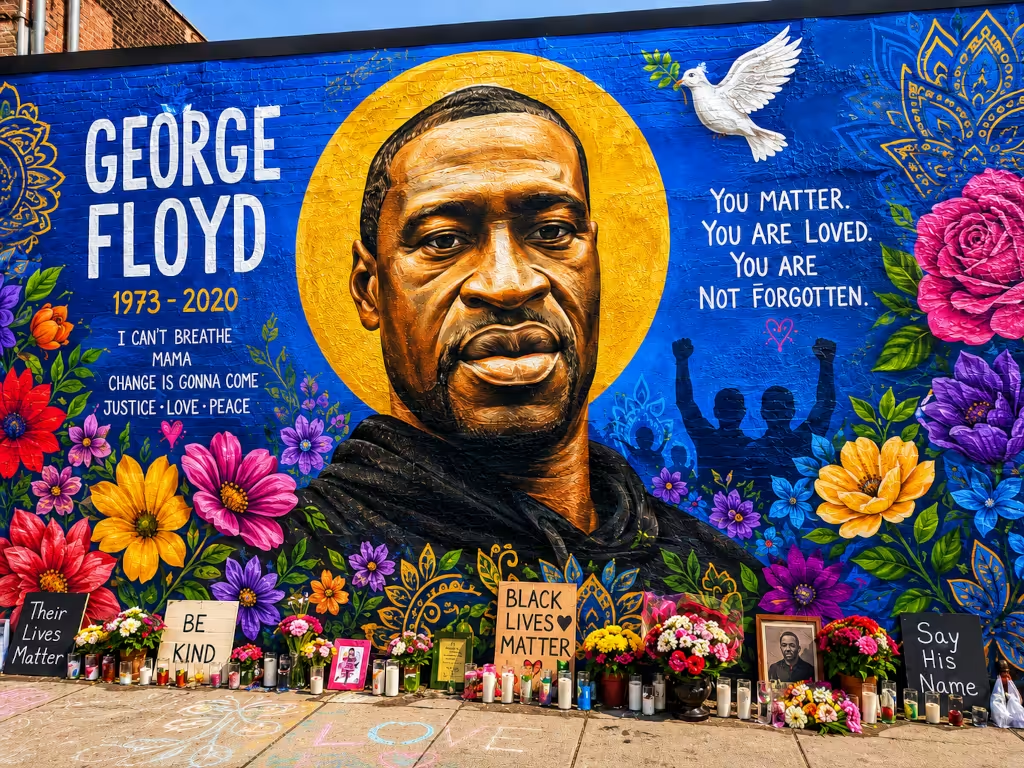
George Floyd’s May 2020 killing by Minneapolis police became one of the defining police-accountability cases in modern American history. Derek Chauvin was convicted of murder, and all four former officers involved in the incident were later convicted in federal court.
On May 25, 2020, George Perry Floyd Jr., a 46-year-old Black man, was detained outside Cup Foods in Minneapolis after a report involving an alleged counterfeit $20 bill. What began as a minor police call became one of the most consequential law-enforcement scandals in U.S. history.
During the arrest, former Minneapolis Police Officer Derek Chauvin restrained Floyd on the ground while Floyd was handcuffed. Video of the incident showed Floyd repeatedly saying he could not breathe as bystanders pleaded with officers to stop. The Hennepin County Medical Examiner later listed Floyd’s cause of death as “cardiopulmonary arrest complicating law enforcement subdual, restraint, and neck compression” and classified the manner of death as homicide.
Chauvin was convicted in Minnesota state court of second-degree unintentional murder, third-degree murder, and second-degree manslaughter. He was sentenced to 22.5 years in prison. In 2023, the U.S. Supreme Court declined to hear Chauvin’s appeal, leaving his state conviction and sentence in place, according to the Associated Press.
Chauvin also pleaded guilty in federal court to violating George Floyd’s civil rights. The U.S. Department of Justice said Chauvin was sentenced to 252 months in prison for depriving Floyd and a then-14-year-old child of their constitutional rights.
The other former officers involved in the incident also faced federal accountability. The Justice Department said Tou Thao, J. Alexander Kueng, and Thomas Lane were convicted of federal civil-rights violations tied to Floyd’s death. Thao and Kueng were found guilty of failing to intervene to stop Chauvin’s unreasonable force, and all three were found guilty in connection with deliberate indifference to Floyd’s serious medical needs.
Federal sentencing followed. The DOJ announced that Thao was sentenced to 42 months in prison, Kueng to 36 months, and Lane to 30 months in the federal civil-rights case. Minnesota state cases against the other officers also resulted in convictions or guilty pleas related to aiding and abetting manslaughter.
The killing also led to a major civil settlement. In March 2021, the Minneapolis City Council unanimously approved a $27 million settlement with Floyd’s family in the civil lawsuit brought against the city and the officers involved.
The fallout went far beyond the criminal courtroom. Floyd’s killing sparked protests across the United States and around the world, intensified scrutiny of police use of force, and forced renewed public debate over racial bias, officer accountability, police training, and the duty of officers to intervene when another officer uses unlawful force.
In 2023, the Justice Department announced that a broader civil investigation found the Minneapolis Police Department and the City of Minneapolis engaged in a pattern or practice of conduct that violated the U.S. Constitution and federal law. DOJ findings included excessive force, unlawful discrimination against Black and Native American people, violations of the rights of people engaged in protected speech, and discriminatory responses involving people with behavioral-health disabilities.
George Floyd’s death remains one of the clearest modern examples of how a routine police call can turn fatal when force, restraint, supervision, medical neglect, and officer inaction collide. The criminal convictions, federal civil-rights cases, civil settlement, and federal investigation all point to the same central issue: police power without accountability can destroy lives, families, and public trust.