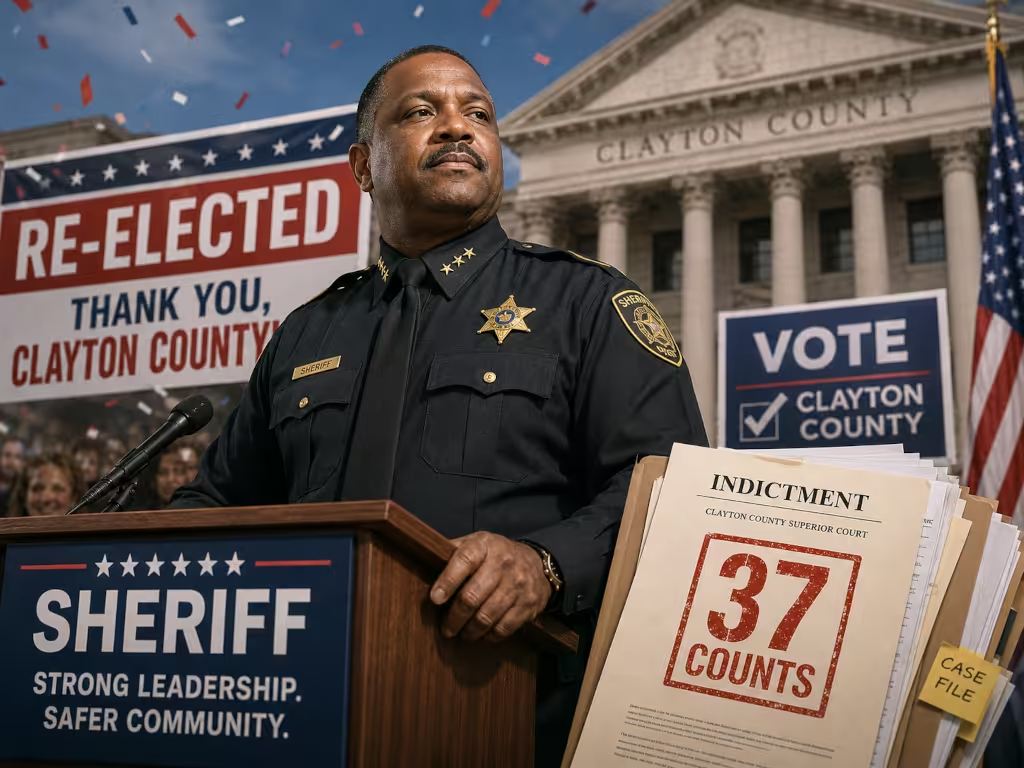
Victor Hill’s career as Clayton County sheriff has long been defined by controversy, political survival, and legal battles. One of the most remarkable chapters came in 2012, when Hill was facing a 37-count indictment but still managed to win back the sheriff’s office.
According to WSB-TV, a Clayton County grand jury indicted Hill in January 2012 on charges that included racketeering, theft by taking, making false statements, violation of oath of office, and influencing a witness. Prosecutors alleged that Hill misused county vehicles, county credit cards, campaign money, and county resources during his earlier time as sheriff.
Hill had previously lost the sheriff’s office in 2008. At the time of the 2012 indictment, he was a former sheriff trying to make a political comeback. Despite the criminal case hanging over him, Hill maintained his innocence and continued his campaign.
Then came the part that made the case so unusual: Clayton County voters put him back in office anyway.
The Associated Press reported that Hill won the November 2012 general election with about 77 percent of the vote. Hill had already defeated incumbent Sheriff Kem Kimbrough in the Democratic primary, and his only general-election opposition was a write-in campaign by Chief Deputy Garland Watkins.
That meant Clayton County voters returned an indicted former sheriff to the very office prosecutors accused him of abusing.
After Hill’s election, Georgia officials faced another unusual question: could the governor suspend a sheriff who was indicted before he officially took office again? According to WABE, then-Gov. Nathan Deal declined to appoint a review panel, saying state law did not allow him to suspend Hill because the indictment was returned while Hill was not in office.
In other words, Hill’s timing mattered. Had he been indicted while serving as sheriff, the suspension process may have been different. Because he was indicted as a former sheriff and then elected again, he was able to take office while the criminal case remained pending.
The 37-count indictment was later narrowed through court rulings and pretrial developments. In May 2013, the Georgia Court of Appeals addressed the state’s attempt to appeal the dismissal of several counts from the indictment. A summary of the decision is available through FindLaw.
Hill’s state corruption case ultimately ended without a conviction. In August 2013, the Associated Press reported that jurors acquitted him of 27 felony charges, including theft-related and false-statement counts. The acquittal allowed Hill to continue his law-enforcement career.
But Hill’s later career would bring another, separate criminal case — and this time, a conviction.
In 2021, the U.S. Department of Justice announced that Hill had been indicted on federal civil-rights charges involving the use of restraint chairs at the Clayton County Jail. Federal prosecutors alleged that Hill ordered pretrial detainees strapped into restraint chairs for hours without legal justification. The DOJ’s announcement is available here.
Hill was later convicted in federal court. In March 2023, the Department of Justice announced that the former sheriff had been sentenced to 18 months in federal prison for violating the civil rights of six pretrial detainees. The sentence also included six years of supervised release, 100 hours of community service, and a restriction barring him from working in law enforcement or serving as a law-enforcement consultant.
In 2024, the U.S. Court of Appeals for the Eleventh Circuit affirmed Hill’s federal conviction. The court’s opinion, available through Justia, rejected Hill’s appeal and upheld the jury’s verdict.
The 2012 election remains one of the most striking examples of the gap between criminal allegations and political accountability. Hill was not convicted in the 2012 state corruption case, and the presumption of innocence applied then as it does in every criminal case. But the fact remains that Clayton County voters knowingly returned him to power while he was under a major felony indictment.
For critics of law-enforcement misconduct, the Victor Hill case raises a larger question: what does accountability mean when voters, political structures, and legal timelines allow an indicted law-enforcement official to regain control of the very office at the center of the allegations?