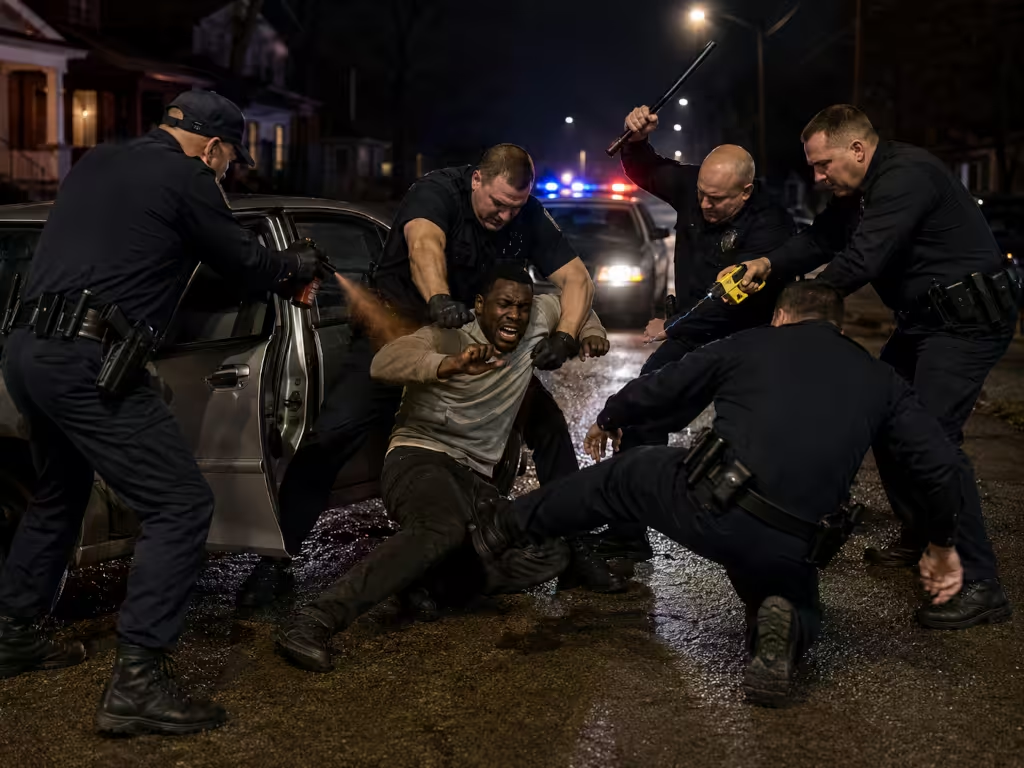
Tyre Nichols was 29 years old, close to home, and reportedly stopped for alleged reckless driving when members of the Memphis Police Department’s now-disbanded SCORPION Unit pulled him over on January 7, 2023.
Three days later, Nichols was dead.
The five Memphis police officers tied to the encounter — Tadarrius Bean, Demetrius Haley, Desmond Mills Jr., Emmitt Martin III, and Justin Smith — were fired, criminally charged, and became the center of one of the most widely scrutinized police brutality cases in the country.
According to the U.S. Department of Justice, a federal grand jury indicted the five former Memphis police detectives in September 2023 on civil rights, conspiracy, and obstruction charges connected to Nichols’ death. The indictment alleged the officers violated Nichols’ constitutional rights by using unreasonable force, failing to intervene, failing to render medical aid, and participating in efforts to cover up what happened.
The case began as what police initially described as a reckless-driving stop. However, Memphis Police Chief Cerelyn “CJ” Davis later said the department had not been able to substantiate the basis for the traffic stop, according to The Independent.
Video released after Nichols’ death showed officers forcibly removing him from his vehicle, using pepper spray and a Taser, and later catching up to him near his parents’ home. Reporting by the Associated Press described the encounter as officers punching, kicking, and striking Nichols with a police baton. Nichols died on January 10, 2023.
An official autopsy determined Nichols died from blunt force trauma and that the manner of death was homicide, according to ABC News.
Federal Charges And Pleas
Two of the former officers, Desmond Mills Jr. and Emmitt Martin III, pleaded guilty in federal court. The Justice Department said Martin pleaded guilty in August 2024 to civil rights and conspiracy charges, including using excessive force, failing to intervene, and conspiring to cover up the unlawful force by omitting material information and giving false or misleading information.
Mills had previously entered a guilty plea in November 2023 to civil rights and conspiracy charges. Both Mills and Martin also reached state plea agreements, according to the Associated Press.
Bean, Haley, and Smith went to federal trial. In October 2024, the Justice Department announced that a federal jury had found the three former officers guilty of federal felonies related to Nichols’ death. Haley was convicted of civil rights and obstruction-related charges, while Bean and Smith were convicted of obstruction of justice through witness tampering.
State Trial Ends In Acquittals For Three Officers
The state case ended very differently for Bean, Haley, and Smith.
On May 7, 2025, a Tennessee jury found the three former officers not guilty on all state charges, including second-degree murder, aggravated assault, aggravated kidnapping, official misconduct, and official oppression.
The acquittals did not erase the federal guilty pleas entered by Mills and Martin, and they did not end the federal case against Bean, Haley, and Smith. However, the federal case later became procedurally complicated.
New Federal Trial Ordered
In August 2025, U.S. District Judge Sheryl Lipman ordered new federal trials for Bean, Haley, and Smith after finding that communications involving the prior judge and prosecutors created an appearance of possible bias, according to Reuters. Lipman reportedly found the prior judge’s rulings were legally sound, but said a new trial was necessary to preserve the appearance of justice.
In April 2026, Action News 5 reported that the Sixth Circuit dismissed cross-appeals filed by Demetrius Haley, Tadarrius Bean, Justin Smith, and Emmitt Martin III for lack of jurisdiction. The report said Bean, Haley, and Smith had been granted a new trial by the district court, while Martin and Mills, who pleaded guilty, were not included in that new trial.
The SCORPION Unit Was Disbanded
All five officers were members of the Memphis Police Department’s SCORPION Unit, a specialized crime-suppression unit whose name stood for Street Crimes Operation to Restore Peace in Our Neighborhoods. After Nichols’ death, the unit was disbanded.
The case became a national symbol of aggressive policing, specialized police units, failed supervision, and the difference between internal discipline, state criminal charges, federal civil rights charges, and civil litigation. Nichols’ family also filed a $550 million federal lawsuit against the City of Memphis and others connected to the case.
For the public, the most basic fact remains the hardest one to ignore: Tyre Nichols did not survive a police encounter that began with an alleged traffic stop. Five officers lost their jobs. Two pleaded guilty. Three were acquitted in state court. The federal case against those three remained tangled in appeals and retrial proceedings.
What happened to Nichols was not a paperwork problem, a training memo, or a public-relations failure. It was a deadly police encounter captured on video, followed by years of criminal proceedings, guilty pleas, acquittals, appeals, and unanswered questions about how a specialized police unit was allowed to operate this way in the first place.