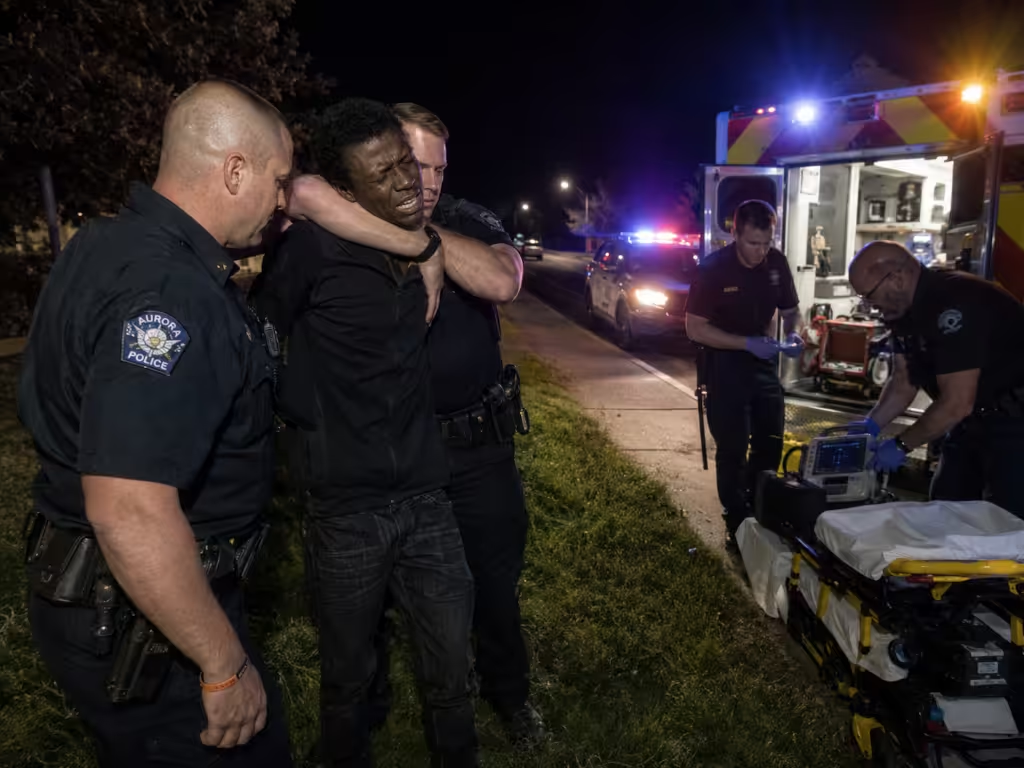
Randy Roedema, an Aurora Police Department officer involved in the August 24, 2019 stop of Elijah McClain, became the only police officer convicted in the criminal cases tied to McClain’s death. This was not a case where every accused first responder was convicted. Roedema was convicted. Former Aurora officer Jason Rosenblatt was acquitted. Aurora officer Nathan Woodyard was acquitted in a separate trial. The criminal case against the paramedics later developed separately on appeal.
Reports And Documented Background
According to the city of Aurora’s public timeline, Aurora police stopped Elijah McClain near Billings Street and East Colfax Avenue after a resident called 911 to report a suspicious person. The stop occurred on August 24, 2019. The Colorado Attorney General’s Office later described the case as involving conduct during a stop that resulted in McClain’s death after he was transported to the hospital, declared brain dead on August 27, 2019, and removed from life support on August 30, 2019. Sources: City of Aurora timeline and Colorado Attorney General indictment announcement.
An independent investigation commissioned by Aurora later found that officers lacked a legal basis to stop, frisk, or use the neck hold on McClain. That finding was part of an independent report and should be understood as a report finding, not as a criminal verdict by itself. Source: The Guardian report on the independent investigation.
Allegations At Trial
Prosecutors alleged that Roedema and other officers restrained McClain and that the restraint contributed to what happened afterward. Prosecutors also argued that Roedema and Rosenblatt encouraged paramedics to administer ketamine by describing McClain as showing signs associated with “excited delirium,” while not telling paramedics about McClain’s repeated statements that he could not breathe. Source: Associated Press verdict coverage.
Defense attorneys pointed to the ketamine administered by paramedics as the cause of death and argued that officers had to react in the moment. Roedema’s defense also argued that McClain resisted and allegedly reached for an officer’s gun. Prosecutors disputed the gun-grab claim. Source: Associated Press trial coverage.
Charges
On September 1, 2021, a statewide grand jury indicted Aurora Police officers Randy Roedema and Nathan Woodyard, former Aurora Police officer Jason Rosenblatt, and Aurora Fire Rescue paramedics Jeremy Cooper and Peter Cichuniec. The Colorado Attorney General’s Office said the 32-count indictment included felony charges such as manslaughter, criminally negligent homicide, and second-degree assault. A grand jury indictment is an accusation, not a conviction, and all defendants were presumed innocent unless and until proven guilty. Source: Colorado Attorney General announcement.
Conviction
On October 12, 2023, an Adams County jury found Roedema guilty of criminally negligent homicide, a felony, and assault in the third degree, a misdemeanor. The same jury acquitted former Aurora officer Jason Rosenblatt of all charges. Aurora’s public timeline also records that Nathan Woodyard was acquitted of all charges in a later trial on November 6, 2023. Sources: City of Aurora timeline and Associated Press verdict coverage.
Sentencing
On January 5, 2024, Judge Mark Warner sentenced Roedema to 14 months in jail. Reporting from Colorado Public Radio said the sentence also included four years of probation, 200 hours of community service, and work-release authorization. Source: Colorado Public Radio sentencing coverage.
Lawsuits And Civil Settlement
McClain’s family filed a federal civil rights lawsuit against Aurora and others in 2020. Aurora later agreed to pay $15 million to settle the lawsuit brought by McClain’s parents. A settlement is not the same as a criminal conviction, but it was a major civil resolution connected to the same death. Source: Associated Press settlement coverage.
Official Statements And Later Developments
When announcing the indictment, Colorado Attorney General Phil Weiser said the state’s goal was to seek justice for Elijah McClain, his family, his friends, and Colorado. Aurora’s own public page says the city’s timeline includes independent review material and reform-related steps that followed the case. Sources: Colorado Attorney General announcement and City of Aurora timeline.
Roedema appealed his conviction. Separately, in June 2026, the Colorado Court of Appeals reversed the criminally negligent homicide convictions of paramedics Jeremy Cooper and Peter Cichuniec and ordered new trials on those counts, while leaving Cichuniec’s separate assault conviction in place. That appellate ruling involved the paramedics and does not erase the fact that Roedema was convicted by a jury. Sources: Associated Press report on Roedema’s appeal and Associated Press report on the paramedic appeal ruling.
Uncorroborated Claims
This story does not rely on uncorroborated social-media claims, rumor, or unsupported allegations. Where the facts are disputed, the dispute is identified as a prosecution allegation, defense argument, report finding, official statement, civil lawsuit, conviction, acquittal, or later appellate development.
Bottom line: Randy Roedema was not merely accused. He was convicted of criminally negligent homicide and third-degree assault after the 2019 stop of Elijah McClain. The case remains a brutal marker in Aurora’s public-safety history: a young man walking home, a police stop that should have been questioned from the start, and one officer ultimately held criminally responsible while other defendants saw mixed outcomes in court.