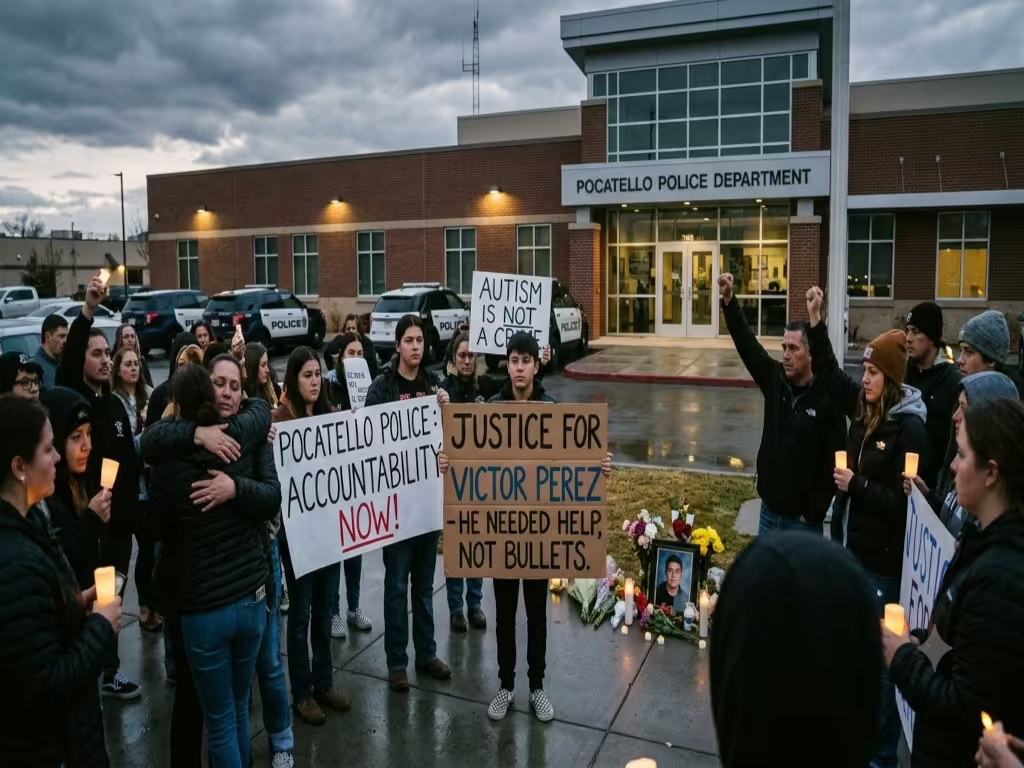
The fatal police shooting of 17-year-old Victor Perez has become another grim example of what can happen when officers respond to a disability-related crisis with guns drawn instead of patience, distance, and de-escalation.
Perez, described in public reports and official records as autistic, nonverbal, developmentally disabled, and affected by cerebral palsy, was shot by Pocatello Police Department officers on April 5, 2025, in the backyard of his family’s home. He later died after being removed from life support.
According to the Idaho Attorney General’s review letter, four Pocatello officers responded after a 911 caller reported a disturbance involving a person with a knife. The Attorney General’s Office acknowledged that Perez suffered from developmental delays, autism, and other medical conditions, and that the public release of videos showing the shooting was met with outrage.
The encounter moved with horrifying speed. CBS News reported that body camera and security footage showed officers shooting Perez only seconds after arriving. Perez was behind a chain-link fence. Three officers reportedly fired handguns, while a fourth officer fired a beanbag round from a shotgun.
The Attorney General’s letter stated that the responding officers were not aware of Perez’s age or disabilities when they arrived. It also stated that dispatch information described a person who appeared intoxicated and was armed with a knife. But that explanation has done little to quiet public anger over the decision to rush the fence, shout commands, and fire before the situation could be slowed down.
The Fence, The Commands, And The Gunfire
The official review said officers arrived in separate patrol cars, moved toward the backyard fence, and focused on Perez because he matched the description they had been given. The letter said officers yelled commands for Perez to drop the knife, and that Perez stood up and moved toward them while holding it.
But the same official review also admitted several important points that critics have seized on: the officers could have stepped back from the fence, could have kept distance in the first place, and had access to less-lethal options. The Attorney General’s Office nevertheless concluded that Idaho law did not require them to retreat or attempt less-lethal methods before using deadly force.
That is the part many people find impossible to accept. A disabled teenager was in his own backyard. A fence separated him from police. Family members were nearby. The situation was chaotic, but it was not a mystery that the person in crisis was not responding normally. Instead of buying time, the officers closed distance and fired.
No Criminal Charges
On September 3, 2025, Idaho Attorney General Raúl Labrador’s office announced that it would not file criminal charges against the officers involved in Perez’s death. In its official announcement, the office said its role was limited to determining whether prosecutors could prove beyond a reasonable doubt that a crime had been committed and that the officers’ use of force was not justified under Idaho law.
The Attorney General’s letter concluded that the state would be unable to prove beyond a reasonable doubt that the officers’ use of force was not justified. The office also made clear that its decision did not address civil liability, employment discipline, or whether the officers complied with department policy.
The City of Pocatello issued a statement saying it respected the Attorney General’s determination, while also acknowledging the grief and pain surrounding Victor’s death.
The Civil Lawsuit Moves Forward
The criminal review may be closed, but the civil fight is not. Perez’s family has pursued legal action against the City of Pocatello. The Associated Press reported that attorneys for the family filed a wrongful death claim, alleging excessive force and emotional distress suffered by family members who witnessed the shooting.
East Idaho News reported that after the Attorney General declined charges, an attorney for the Perez family said the civil litigation was just getting started. The same report stated that Perez had been described as autistic and developmentally disabled, underwent multiple surgeries, had his leg amputated, and was taken off life support after doctors found him clinically brain-dead.
A later public report by the Pocatello Chubbuck Observer said an amended federal complaint listed claims including excessive force, violation of the Americans with Disabilities Act, negligence, wrongful death, and assault and battery. That report is available here.
Why This Case Belongs In The Public Record
This case is not just about one shooting. It is about how police respond when someone in crisis is disabled, confused, nonverbal, or unable to process shouted commands from armed strangers.
Police departments routinely claim that officers are trained to handle dangerous, unpredictable situations. But when a disabled teenager behind a fence is shot within seconds of officers arriving, the public has every right to question what that training is worth.
The Attorney General’s decision may mean the officers will not face criminal charges under Idaho law. It does not mean the shooting was wise. It does not mean the tactics were sound. It does not mean the public should forget what happened. And it certainly does not erase the fact that Victor Perez is dead.
For Perez’s family, the civil case may be the only remaining path toward accountability. For the public, the case stands as another warning that “officer safety” too often becomes the excuse for tactics that leave vulnerable people dead.
Initially, the four Pocatello Police Department officers involved in the shooting of Victor Perez have not been publicly identified by state or local officials.
The Pocatello Police Department, the Eastern Idaho Critical Incident Task Force, and the Idaho Attorney General’s Office have withheld their names throughout the investigation and subsequent announcements. Even when the Attorney General’s Office released its final 12-page legal report clearing them of criminal charges, the names of the officers were omitted from the public documentation.
However, the Perez family filed a federal civil rights lawsuit against the City of Pocatello. While the city and the police chief are named directly, the individual officers may initially be listed as “John Does” until their identities are formally uncovered and added to the suit through the legal discovery process.
For a deeper dive into the legal review and findings that kept these identities hidden, you can watch the East Idaho News Broadcast on Victor Perez. This video provides local investigative coverage detailing the Attorney General’s decision and the systemic dispatch failures that led to the shooting.
The federal lawsuit names the City of Pocatello, Police Chief Roger Schei, and Officers Dillon Behunin, Tyler Evans and Jordan Williams as defendants.
Presumption Notice: No criminal charges were filed against the officers in connection with this shooting. Civil allegations remain allegations unless proven in court. This article summarizes public reporting, official statements, and litigation-related claims.