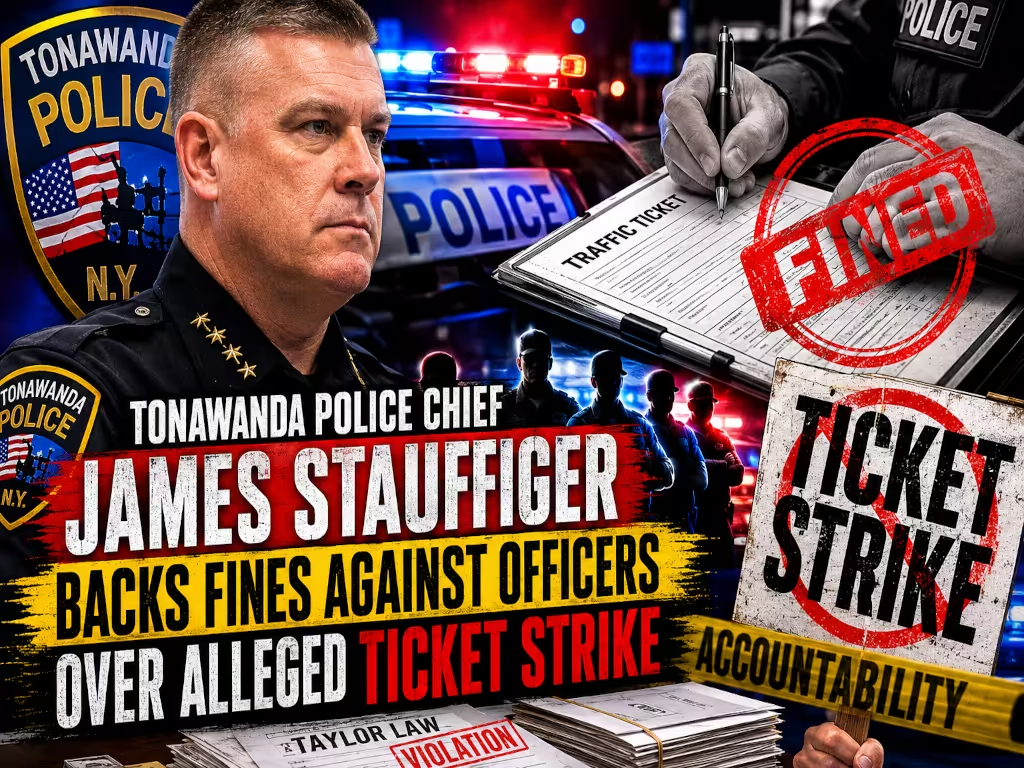
In the Town of Tonawanda, a dispute between police leadership, town officials, and rank-and-file officers turned into a rare public fight over whether police officers can be punished for allegedly refusing to write tickets.
The controversy centered on accusations that members of the Town of Tonawanda Police Department engaged in what town officials described as an unlawful “ticket-writing boycott” or “ticket strike” during a three-week period in early 2025. According to WKBW, Town Supervisor Joseph Emminger said the alleged strike took place roughly from January 16 through February 5, when a large number of officers allegedly did not issue tickets.
The Town Board voted to take legal action against the Town of Tonawanda Police Club, the union representing rank-and-file officers, alleging that the conduct violated New York’s Taylor Law. Under New York Civil Service Law § 210, public employees and employee organizations are prohibited from engaging in strikes. The New York Public Employment Relations Board also explains that a strike can include slowdowns or partial refusals to perform normal duties, depending on the facts, and that public employees found to have unlawfully struck may face the so-called “two-for-one” penalty: a deduction equal to twice the employee’s daily rate of pay for each day or part of a day of violation, according to PERB’s public guidance.
In April 2025, WKBW reported that some Tonawanda officers were receiving letters from Emminger notifying them of fines connected to the alleged illegal strike. The town’s investigation alleged that officers stopped or reduced ticket issuance for three weeks because of frustrations with department leadership, and the findings were forwarded to PERB.
Police Chief James Stauffiger publicly backed the town’s action. In an interview with Fox News Digital, Stauffiger said he stood behind the charges filed against the union and individual officers, while also saying the process needed to unfold fairly and thoroughly.
The police union strongly denied that any strike occurred. Union President Andy Thompson argued that officers showed up, worked their shifts, handled calls, and did not simply stop working. He claimed the town was punishing officers because they did not write enough tickets, raising the obvious and uncomfortable question of whether this was really about public safety, labor discipline, or ticket revenue.
That issue matters because New York law also restricts ticket quotas. New York Labor Law § 215-a prohibits employers from penalizing police officers for failing to meet quotas for tickets, summonses, arrests, or stops. The union framed the discipline as punishment for failing to generate enough citations. Town officials framed it as an unlawful coordinated slowdown by public employees.
According to reporting summarized by Police1, the dispute also became tangled with broader tensions involving Chief Stauffiger, officer discipline, and the resignation of Officer Bikramjit Singh after allegations involving mishandled evidence. Union leaders accused Stauffiger of creating a toxic culture, while town officials defended the chief and said officers had not shown a valid reason for his removal.
The fight eventually moved toward resolution. In June 2025, WKBW reported that the town and police union reached an agreement under which 44 officers accused of striking would pay fines totaling $17,000, with individual fines ranging from $100 to $700. The police club would also lose one month of dues, there would be no further punishment from the town, and a Labor Management Committee would be formed.
Buffalo Toronto Public Media reported that the agreement reduced the Taylor Law fines for officers by half while preserving their right to appeal the fines.
For the public, the Tonawanda case exposes an ugly reality: police departments and municipalities often insist that ticket quotas do not exist, yet the sudden collapse of ticket numbers became the basis for punishment. If officers truly engaged in a coordinated slowdown, then the public was dealing with uniformed public employees using enforcement discretion as a labor weapon. If the union’s position is correct, then officers were punished for not writing enough tickets, which creates a different but equally disturbing accountability problem.
Either way, Chief James Stauffiger did not distance himself from the town’s case. He supported the charges against the union and individual officers, while the union accused him and town officials of retaliation and mismanagement. The result was a public fight over police accountability, labor power, ticket enforcement, and whether “doing the job” means protecting the public — or producing enough citations to satisfy the people in charge.
As with all cases involving allegations, administrative charges, or employment discipline, readers should distinguish between accusations, findings, settlements, and criminal convictions. This matter involved alleged Taylor Law violations and employment-related penalties, not criminal charges against the officers.