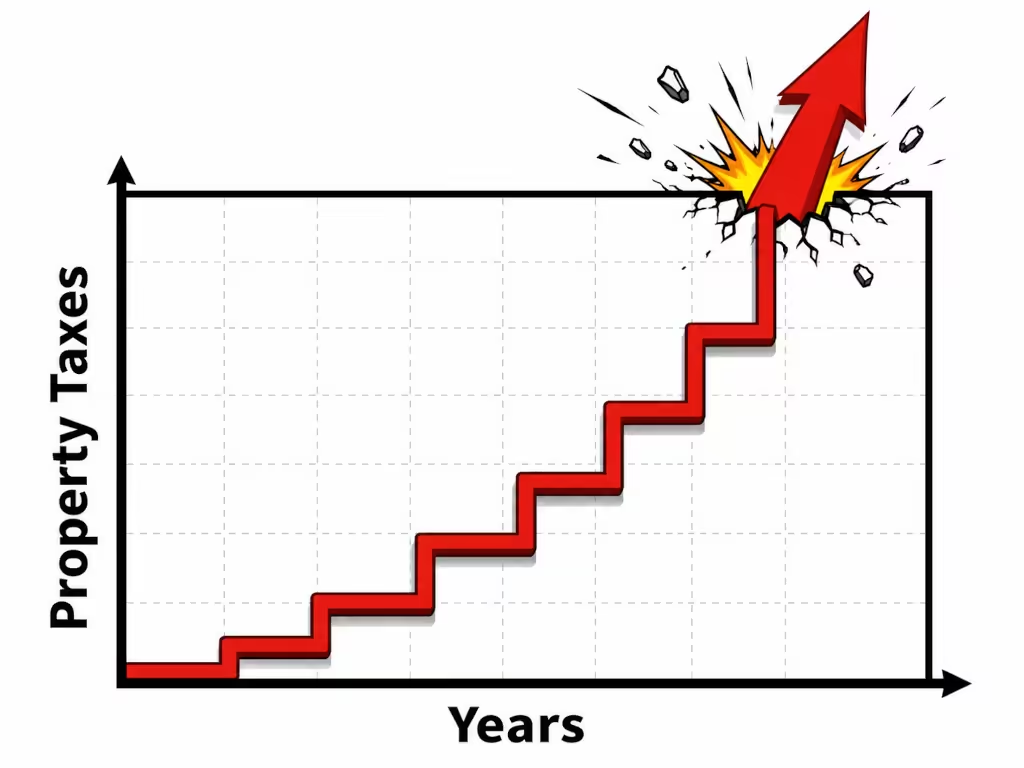
Clayton County Property Taxes: Higher Bills, Rising Values, and the 2024 Tax Jump. While not directly connected to a “Fucked Cop”, this story is important because the Clayton County Sheriff, Levon Allen, claims he needs more money for his department. A lot more, apparently. Remember that EV fiasco? For this story, a residential property built in the late 80s with an annual tax of approximately $1,000 in 2010 was reviewed.
The annual tax about 15 years later is nearly $4,500. Probably closer to $5,000 today. Clayton County residents should be pissed! Maybe the voters should demand better quality government or, better yet, reduce government waste. It is hard to imagine how these types of increases are sustainable. But wait, aren’t these the same voters that reelected Sheriff Victor Hill even after Hill was indicted on 37 counts? Yes, the same people. Dumbasses? Almost certainly!
Clayton County property owners have had plenty of reason to feel squeezed over the last decade, but the story is not as simple as saying the county kept raising the tax rate every year. In many years, the county’s stated millage rate actually went down. The bigger issue has been rising property values, reassessments, and a growing tax digest that allowed the county to collect substantially more money even when the rate itself was lower.
In Georgia, property tax bills are driven by more than just the advertised millage rate. Property taxes are generally calculated using the property’s assessed value, exemptions, and the applicable millage rates. The Georgia Department of Revenue explains that one mill equals $1 for every $1,000 of assessed value, and Georgia generally uses 40% of fair market value as the assessed value for tax purposes. Clayton County’s Tax Commissioner provides the same basic explanation: property value minus exemptions, multiplied by the millage rate, determines the amount owed.
That distinction matters because Clayton County’s tax base has grown sharply. According to county-published digest history, Clayton County’s countywide net digest value rose from approximately $6.34 billion in 2017 to approximately $10.35 billion in 2022. During that same period, the county maintenance and operations, or M&O, millage rate fell from 16.596 mills to 14.496 mills. Even with the lower rate, county M&O taxes levied increased from about $105.2 million to about $150.1 million.
By 2025, Clayton County’s countywide net digest had grown even further, reaching approximately $13.76 billion. The county M&O rate for 2025 was 14.552 mills, and the county M&O taxes levied were listed at approximately $200.3 million. In practical terms, from 2017 to 2025, the county M&O rate went down by roughly 12%, but the taxable digest more than doubled, and the county M&O levy increased by roughly 90%.
For homeowners, that means a tax bill can rise even when the millage rate does not. If a property’s assessed value increases enough, the owner can pay more despite a flat or even reduced tax rate. That appears to be a major part of what happened in Clayton County over the last decade.
The most obvious flashpoint came in 2024. Clayton County announced a 2024 county M&O millage rate of 15.266 mills, which the county described as a 31.11% increase over the rollback rate. The county stated that the rollback rate would have been 11.644 mills without the increase. In its public notice, the county estimated the increase would amount to about $261.54 for a home with a fair market value of $250,000.
The rollback rate is important. Under Georgia law, when reassessments increase the tax digest, local governments calculate a rollback rate that would produce roughly the same revenue as the previous year, excluding new growth. If officials adopt a rate higher than that rollback rate, it is advertised as a tax increase, even if the headline millage rate appears unchanged or only modestly changed.
Clayton County’s own five-year history shows the scale of the 2024 increase. The county M&O tax levy jumped by 32.83% in 2024. In 2025, the county reduced the county M&O rate to 14.552 mills, and the county M&O levy fell slightly by 0.70% compared with the previous year.
School taxes are another major part of the overall property tax bill. For 2025, Clayton County’s basic county category included a county rate of 14.552 mills and a school M&O rate of 19.600 mills, for a combined total of 34.152 mills before any city-specific add-ons. In fire district areas, the total was 38.298 mills because of an additional 4.146 mills for fire services. Clayton County Public Schools maintained its 19.600 mill rate for 2025 while announcing a 0.26% increase over the rollback rate.
The bottom line is that Clayton County property taxes have risen significantly over the last decade, but much of that increase appears tied to rising assessed values and a growing tax digest rather than a simple year-after-year increase in the county millage rate. The 2024 county increase over the rollback rate, however, stands out as a clear and substantial tax increase.
For individual property owners, the actual impact depends on several factors, including reassessment, exemptions, whether the property is homesteaded, whether the property is inside a city, and whether the property is located in a fire district. Two homeowners with similar houses may still receive different bills depending on those details.
There may also be some relief ahead for certain residents. Clayton County voters approved House Bill 870, a homestead exemption for disabled veterans, senior citizens, certain surviving spouses, and 100% disabled residents, effective January 1, 2026, through December 31, 2030. Separately, Georgia’s 2026 HOME Act, Senate Bill 33, has been described by the Georgia Senate Press Office as capping annual increases in homestead property assessments at inflation beginning in 2027 and closing the local opt-out loophole.
For Clayton County taxpayers, the key lesson is this: do not look only at the millage rate. The tax digest, reassessment notices, exemptions, rollback rate, school taxes, city taxes, and fire district taxes all matter. A lower rate does not automatically mean a lower bill, and Clayton County’s numbers over the last decade show exactly why.
Sources:
- Georgia Department of Revenue — Property Tax Millage Rates
- Clayton County Tax Commissioner
- Clayton County Five-Year Tax Digest History
- Clayton County 2025 Five-Year History
- Clayton County 2024 Property Tax Increase Public Hearings Notice
- Clayton County 2025 Millage Rates
- Clayton County Public Schools 2025 Property Tax Notice
- Clayton County Residents Approve House Bill 870
- Georgia Senate Press Office — HOME Act / Senate Bill 33